
I have to follow the exciting beats and questions as they arise in my mind.
Julie Farrell's neurodivergent notes on writing.


Hello! It’s been a while! Hi again to folks who’ve been around a while and for those who are new subscribers :). I’m very much hoping to get back to more regular interviews every two weeks from this autumn. Honestly, having my debut novel come out has been a whirlwind and I feel like I am only just getting back into my routine now! If you’re interested in my work you can catch me at The Book Nook in Stirling with the wonderful Tom Newlands (friend of the newsletter) on October 7th and we’ll also be at Waterstones Kirkcaldy on October 6th. We’ll be chatting about neurodiversity at both events!
Thanks very much also to those who have chosen to become paid subscribers of the newsletter - this will absolutely always be a free resource but I am very grateful to those who have supported financially as it does help me with the admin side of things.
I’m super pleased to be able to share this interview with Julie Farrell who is a disability advocate and author. She has so much valuable experience to share in her work on accessibility and on the difficulties of balancing activism with one’s own creative life. She also has some great recommendations for other neurodivergent art - including another one for A Kind of Spark!
Hey Julie! Tell us a bit about you and your work.
Hello! I'm a disabled author and award-winning poet based in Edinburgh, and I'm also the director of Inklusion an organisation I co-founded four years ago to create a free guide to making literature events more accessible to disabled people.
Disability, otherness, identity, resilience and autonomy are all themes explored in all my writing. I’m a contributor to Someone Like Me, an anthology of non-fiction by autistic women and gender-diverse writers, out on 25 September, which aims to explode stereotypes and smash stigmas around the autistic experience.
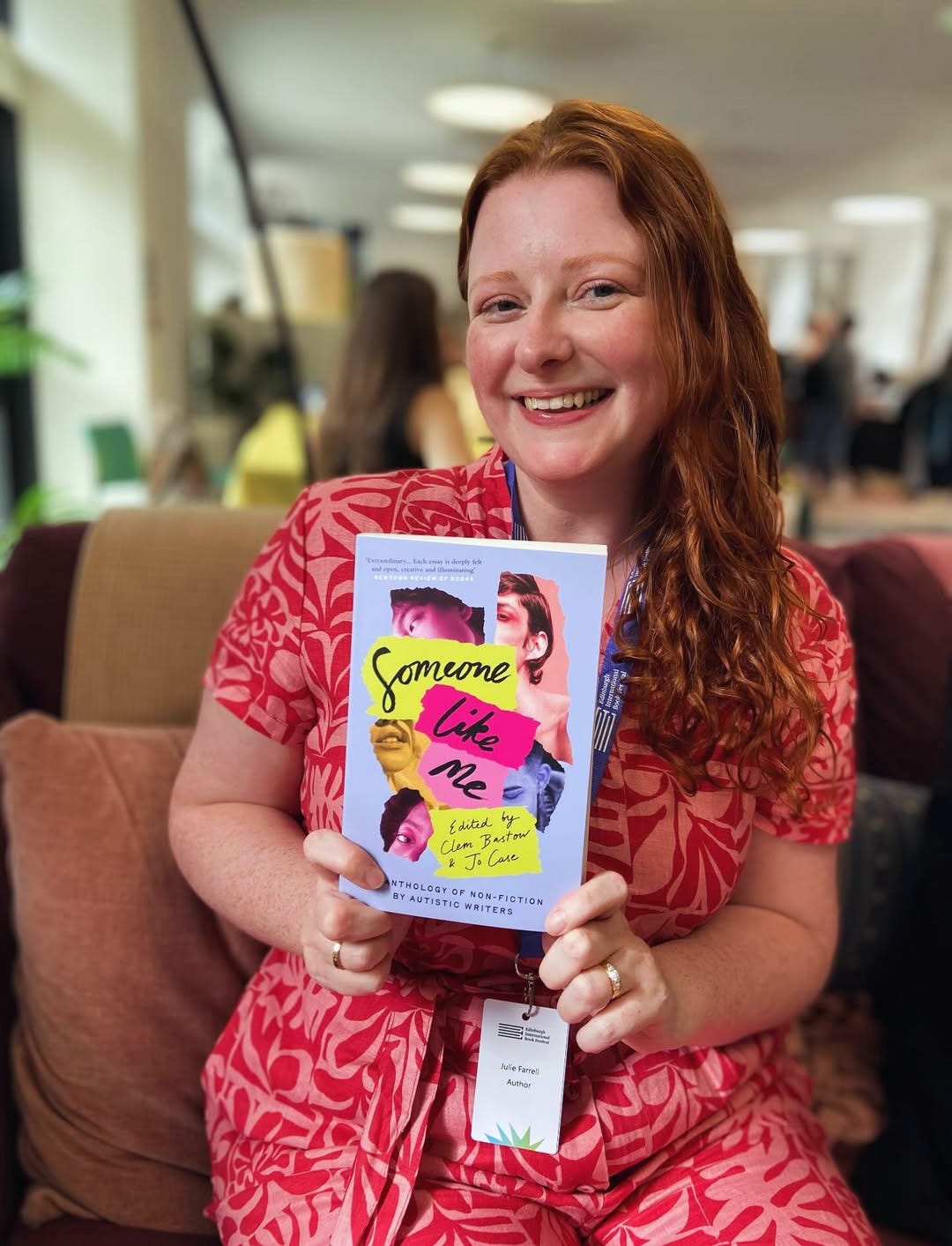
I’m incredibly grateful to be a contributor with some incredible writers, including Naoise Dolan and Lucy Rose, and there are 31 autistic voices being championed and uplifted in this amazing collection. My essay is called Stargazing, and it’s about grief, enduring love and giving ourselves permission to feel wonder as an act of survival. It explores how looking at the stars and planets is a deeply joyful and grounding stim for me, something I only recently came to understand, because I only discovered age 35-37 that I'm AuDHD.
In the years leading up to my assessments (I hate saying diagnosed, I really see it as my neurotype), I started advocating for better support for disabled and low-income writers. Disability representation in books is appalling - approximately 4% - far short of the 20-25% of our population, and no one seems to care. So I decided to make some noise about it.
Our free guide was sponsored by four of the Big 5 publishers, as well as many other organisations, and it's been downloaded over 2000 times from our website. I speak as often as I can to publishers about what they can do to open the gates to disabled writers (you can read a recent article I wrote for the Bookseller, here). It's not enough for them to say 'we welcome disabled writers' - they actually need to go find them and nurture them, by dismantling systemic barriers and creating supported opportunities.
It's my hope to continue my advocacy as a published author with my own creative works, which include a contemporary young adult novel, a nature memoir and a poetry collection. Nature and grief are strong themes in my work, and I think that comes in part from not knowing why I was 'different' as a kid - I'd be out with my nose in the trees and shrubs looking for insects, or in my garden at night with my telescope counting Jupiter's moons, because I was inherently curious, and because they were steadying to me in the chaos of being a young-carer (something I didn't understand at the time).
Does being neurodivergent impact your creative process? And if so how?
Undeniably. In ways both good and bad. I think it's taken me a long time to progress my writing, for a few reasons. For a long time I couldn't afford development opportunities, and I struggled with finding time to write because I had to work to support myself in other capacities, and those other lines of work weren't fully aligned with where I wanted to put my energy which was draining.
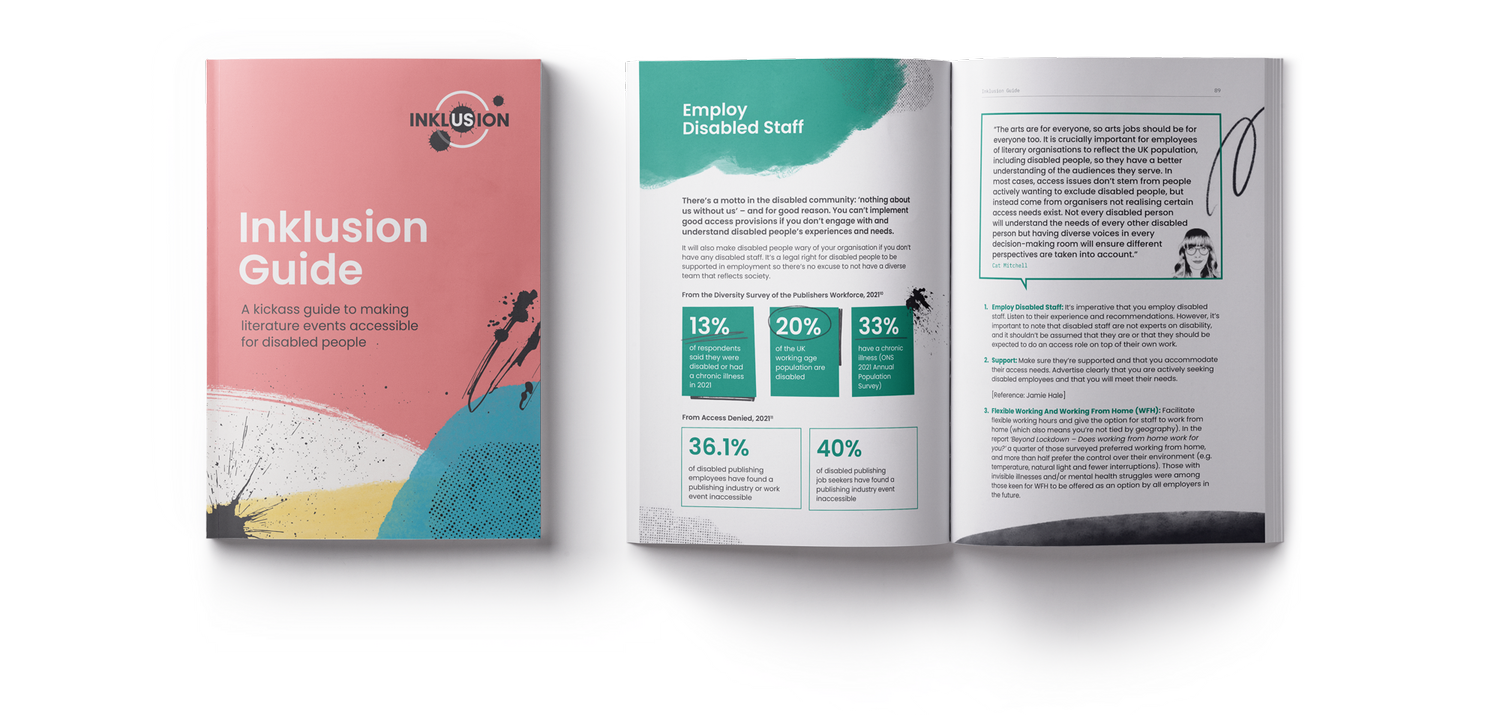
When I could finally afford to quit anything other than writing (thanks to my spouse's support) that's when things really started to progress and take shape. I realise now that I need to hyper-focus on things I enjoy to be good at them. And I love writing, it's my lifeblood. I also love the disabled community, and being an advocate is something I feel a call to be, but it's tricky to balance that with my creative work. My creativity suffered (was almost non-existent) in the four years it’s taken to build Inklusion and deliver the guide, as well as research the impact it’s had on the sector – the results of which I only just published last month in our Impact Report. It’s been amazing to showcase just how positive an impact we’ve had, and it demonstrates that grassroots organisations need and deserve support.
Now that I’ve wound-up my projects with Inklusion, I’m focusing on the launch of Someone Like Me, and on getting back to creative projects, as well as building on some creative collaborations with other artists. I’m excited to be delivering a webinar to Disability Arts Online’s Right to Thrive programme on the 29th September, where I’ll be sharing about my journey as a creative, the barriers I’ve faced, and how I’m advocating for myself as a disabled artist. It feel really good to be in the creative place again, I’ve really missed it.
Being AuDHD means, for me, that I have a strong sense of connection between things – between humans, animals, plants and trees, our environment, the Earth and the wider cosmos. I have an honours degree in Biomedicine, but I studied chemistry, astronomy and astrophysics, and cosmology in my first two years, having always loved all of the sciences, and it gave me such a strong sense of the stuff we're made of, and the scale of things.
We're all stars, made of the first elements of the Big Bang, and the structures and patterns we find in nature and our own nature, are all mirrored. We're just a bunch of neutrons and protons and electrons, repeating and connecting in the same chains and branches, the same carbon and oxygen, muscle and bone and brain. But we're so completely unique, and chaotic, like the cosmos itself. Yet, our evolved and enlightened species, is one chance in mutli-universe (according to our best current quantum mechanics theory). My neurotype lets me understand these connections, ask a lot of questions, and think about the answers on a vast scale that encompasses the smallest thing to the largest. I write about fractal patterns a lot (my YA novel is on submission right now, and it’s titled We Are Fractals) because they are the epitome of this scale.
Practically, I can be organised (I have a lot of folders on my desktop), but I can also be disorganised (what day is it again? Where is my notebook, my pen? Oh no, I have that meeting in five minutes – wait – I need to pee.) I write in jump-cut, or out of order (so far) as I have to just follow the exciting beats and questions as they arise in my mind.
Usually, there's an arc in my mind – like how do we go from A to Z? Then I can be scrappy and take quite a convoluted path to get there – it's not a case of drawing a straight, smooth line, but more like a river darting over here to look at this shiny thing, or curving around that rock because it's not important. I use paper notepads for various different projects, and I change where I work in my house, using my dining table for large-scale narrative layouts (I'm a visual person, always mapping things out), or sitting at my desk surrounded by all my favourite treasures when I'm editing or writing an essay.
Most often, I just sit and try answer the question, whatever it is. I let it flow organically – often I just need a very light edit, sometimes I can feel it going off on a large tangent so I reel it back in and try again, rather than continuing down a new path too far before I realise I'm completely off-track. Sometimes, if I'm really loving the tangent, I let it flow, then stick it in a new file for another day. I also write by recording voice notes when I'm out walking – it unsticks me and helps me to process if I'm tramping through long grass with birdsong in my ears. I’m definitely a kinesthetic thinker.
Is neurodiversity a theme in your work? Or do you write neurodivergent characters?
Yes, more so since my diagnoses. I wrote my YA novel first, in 2016, and I only found out I was autistic five years after that, and that I have ADHD another two years later.
I was very much working through my experience of being a young carer for my mother when I wrote that book, but looking back, it makes total sense that I wrote a dual protagonist story – one is academic, athletic, a perfectionist in many ways, but struggling to be that way; and the other is chaotic, artistic, emotionally dysregulated, and absolutely falling apart. It's like I took my autistic traits and ADHD traits and dished them out to these two protagonists, and worked through them somehow through these characters – who completely became their own wonderful people who I fell in love with.
They are so hard on themselves, like many of us who are neurodivergent are, but ultimately they learn to accept and love themselves, which allows them the freedom to truly love each other, too, in the end. It really is about finding who you really are and being okay with taking off the mask. We all deserve love just for being who we are.
What's one piece of advice would you give to aspiring neurodivergent writers out there?
I think it's really important to learn as much as you possibly can about how the industry works, in terms of how you go about querying agents for different genres, how you structure a story arc, characters, plot, place etc, too. You have to know your project inside-out, but not be so close that you can't frame it succinctly. It will help a lot if you can boil it down to one paragraph, clearly saying who the protagonist/s are, what the obstacle they are facing is to their goal, what they risk to lose if they don't overcome it, and what the core belief is about themself that's holding them back – and thus what they need to change about themself/their beliefs to achieve the goal.
It's deceptively simple but these are huge key elements that really need to be in any story, no matter the genre. We hate being prescriptive, but it's a necessary evil, and it actually will make your story better. Knowing all of this allows you to send out concise and impactful query letters, or speak to an agent in a networking session.
I found it really hard at first to do all of this, and I think our prescriptive requirements are barriers to ND writers, not least because every agent has different specific requirements. Good ones will be very clear about what they want from your query, and they'll keep things simple and easy to find. Also, I have to add, believe in yourself! There are times when it's just you and your book and you have got to cheer yourself on. Rejection is part of the process – again, tricky for those with rejection sensitivity like me – but well warned is well-armed. You've got this.
Is there a book (or other kind of art) by a neurodivergent artist that you love and you'd like to draw our attention to?
So many! I have to say Wintering by Katherine May, because it's all about giving yourself permission to have those fallow periods, which are so, so crucial to our survival in a neurotypical world. We really need to prioritise rest and re-filling the well. Also, A Kind of Spark by Elle McNichol, has a hugely special place in my heart, because it really was the moment where I just knew in my bones I was autistic. And also, ‘Seeing the Unseen’ is a wonderful documentary about late-diagnosed autistic women that also really helped me to understand myself more when I was going through the whole 'but you have a degree and you're successful' narrative during my attempts to get assessed. And finally, Earthed, by Rebecca Schiller, was the book that had the same impact on me, but in terms of understanding I have ADHD. Rebecca has a unique ability to hold you comfortably in a simple narrative, but then there’s all these layers and threads going on in parallel, and you dip in and out – she captured the texture of the ADHD mind beautifully.
What’s one thing the publishing industry could do to make things better and more accessible for neurodivergent writers?
Aside from hiring more neurodivergent staff in senior roles, publishing needs to create specific mentoring programmes for disabled and neurodivergent writers that don't just pick one winner from a competition for further development. Run it a couple of times a year, and tailor it to each writer. Pay the mentors and the mentees. And understand that we don't find the normal routes to securing an agent or building a portfolio or gaining accolades to be remotely easy. It's often the first hurdle that many of us never overcome (querying is like pulling teeth, rejection leads to days of spiralling and impostor-syndrome, and summarising one's own work at times is an impossibility, due to the highly prescriptive and yet vastly varied nature of query requirements, which require significant spoons to manage and keep track of, let alone motivated towards). Also, disabled friendly networking opportunities would be great.
And lastly, how can readers of the newsletter support your work?
It would be wonderful if you'd subscribe to my Substack, Author on the Edge – I love having a chat in the comments, and if you're happy to share the work with others, that would be great. Also, you could buy Someone Like Me (from your local indie, if you can) and tell your friends about it :)!
 | A guest post by
|